
Wasps
Wasps are an integral and fascinating component of Scotland’s natural heritage. The diversity of wasps in Scotland is far greater than many realize:
- Broad Diversity: There are approximately 9,000 species of wasp found throughout the UK, many of which are present across Scottish landscapes.
- The Social Minority: Despite their high profile, only nine species in the UK are “social wasps” that live in large colonies with a queen and workers.
- Common Residents: In Scotland, the two most frequently encountered social species are the Common Wasp (Vespula vulgaris) and the German Wasp (Vespula germanica).
- Solitary and Specialist Species: The vast majority of Scotland’s wasp species are solitary or parasitic. This includes unique varieties like the Heath Sand Wasp, which thrives in coastal dunes and heathlands, and various “gall wasps” that create intricate growths on native trees.
Professionally, these insects are regarded as a “natural pesticide.” By hunting aphids, caterpillars, and other garden pests to feed their larvae, they help maintain the delicate equilibrium of Scotland’s diverse ecosystems.
What makes Wasps different?
While wasps and bees share a common ancestry, they have distinct physical and behavioural characteristics that allow them to occupy different roles in the environment.
The most visible differences lie in their body structure and “finish”:
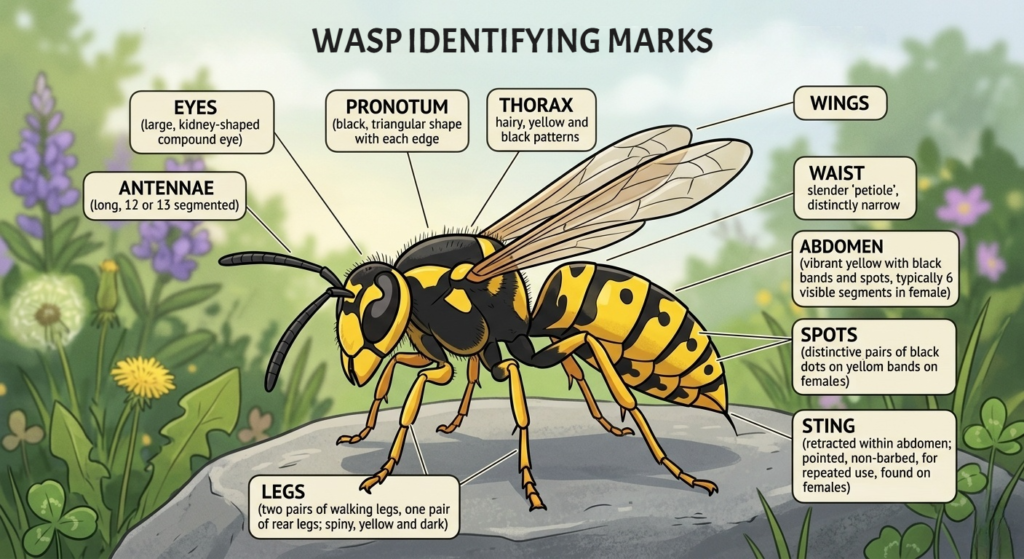
- The “Wasp Waist”: Wasps are characterized by a very narrow, distinct constriction between the thorax and abdomen, known as a petiole. Bees tend to have a more robust, integrated body shape.
- Surface Texture: Most wasps have a smooth, shiny exoskeleton with very few hairs. In contrast, bees (especially bumblebees) are often covered in dense, branched hairs designed to trap pollen.
- Leg Structure: Bee legs are often widened and equipped with specialized structures like pollen baskets (corbicula) for transporting food. Wasp legs are typically thin and cylindrical, suited for hunting and perching rather than heavy foraging.
Their nutritional needs define much of their behavior:
- Predatory Nature: Wasps are primarily hunters. While adults drink nectar for energy, they hunt other insects – such as caterpillars and flies – to provide essential protein for their developing larvae.
- Vegetarian Lifestyle: Bees are almost exclusively “vegetarians.” Both the adults and the larvae rely on nectar and pollen collected from flowers for their entire life cycle.
The way these insects build their homes is a clear indicator of their identity:
- Paper Architects: Social wasps create their nests using “wasp paper,” a material made by chewing wood fibers mixed with saliva into a pulp.
- Wax Builders: Bees, such as honeybees and bumblebees, produce wax from specialized glands on their bodies to construct the hexagonal cells or pots used for rearing young and storing food.
While both can be defensive if their home is threatened, their general interaction with the world differs:
- Wasps: Often more curious and opportunistic, wasps are attracted to human food—particularly sugary drinks or proteins—which leads to more frequent interactions with people.
- Bees: Generally more focused on floral resources. Unless you are near a nest or accidentally step on one, bees typically ignore human activity in favour of finding the next bloom.
Gallery


Our Removal Guarantee
We offer a guarantee on any service our controller agrees to perform, unless otherwise stated. Please note that the Poison and Extraction guarantees do not cover any new nests discovered after the controller’s visit.
Poison Guarantee: If a treated nest remains active, we’ll provide free follow-up treatments within 14 days of the original service. Please note that this guarantee doesn’t cover nearby areas or spaces around the nest.
Extraction Guarantee: If wasps or bees start rebuilding in the same spot after a nest has been removed, we’ll offer a consultation and, if needed, a free return visit to address the issue.
Advisory Guarantee: If no nest or infestation is found, we’ll provide professional advice during your visit (standard callout fee applies). Plus, if a nest or infestation appears within 14 days, we’ll return and treat it for free.
More details on how we remove bees and wasps are found here.
Some of the Wasps in Scotland
- Common Wasp (Vespula vulgaris)
- German Wasp (Vespula germanica)
- Norwegian Wasp (Dolichovespula norwegica)
- Tree Wasp (Dolichovespula sylvestris)
- Red Wasp (Vespula rufa)
- Saxon Wasp (Dolichovespula saxonica)
- Median Wasp (Dolichovespula media)
- Austrian Wasp (Vespula austriaca)
- European Hornet (Vespa crabro)
Fun Fact
While adult social wasps primarily drink nectar for energy, they are actually carnivorous hunters. They capture other insects – such as caterpillars and flies – to provide a high-protein diet for their developing larvae back in the nest.