
Bumblebees
Bumblebees are an essential part of this ecosystem, acting as hardy, industrious workers that remain active even in the cooler, mistier conditions of the north.
While they may all share that signature “fuzz” and gentle buzz, Scotland boasts an impressive level of biodiversity within the family of bumblebees (genus Bombus). There are 23 species of bumblebee found across the country, ranging from the ubiquitous Buff-tailed Bumblebee found in suburban gardens to the incredibly rare Great Yellow Bumblebee, which now finds its primary stronghold in the Scottish islands.
Understanding these 23 species is key to appreciating the health of the Scottish environment. Whether they are nesting in old rodent burrows or foraging among the heather, each species plays a vital role in pollinating our native flora and supporting the agricultural heritage of the region.
What makes Bumblebees different?
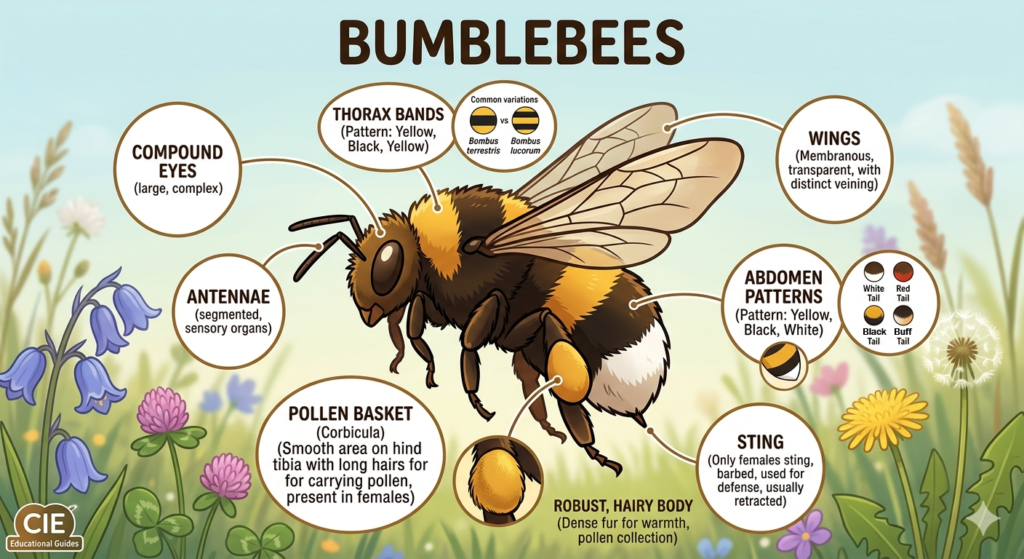
The most immediate difference is their hairy appearance. Bumblebees are densely covered in branched hairs called setae. This isn’t just for aesthetics; it acts as a high-performance insulation layer, allowing them to fly in temperatures as low as 10 °C -conditions that would leave honeybees grounded.
Bumblebees are social, but on a much smaller scale than honeybees:
- Population: A honeybee hive can house 50,000 individuals, whereas a bumblebee nest typically contains as few as 50 bees.
- Lifespan: Unlike honeybee colonies that can survive for years, bumblebee colonies are annual. Only the new queens survive the winter by hibernating underground; the rest of the colony perishes in late autumn.
While wasps and bumblebees are often confused due to their yellow-and-black warning colors, they occupy very different niches:
- Diet: Adult bumblebees and wasps both feed on nectar for energy. However, wasps are predatory carnivores that hunt other insects to feed their larvae, while bumblebees are strict vegetarians, feeding their young exclusively on pollen.
- Body Shape: Wasps have a distinctively narrow “wasp waist” and a smooth, shiny exoskeleton. Bumblebees are robust and “round,” lacking that sharp constriction.
- Temperament: Wasps are generally more opportunistic and defensive. Bumblebees are famously docile; they are focused entirely on foraging and will rarely sting unless handled or if their nest is directly stepped on.
Gallery
Our Removal Guarantee
Bumblebee treatments can usually be guaranteed, though the treatment may take a few days to take full effect. The controller will determine the most suitable approach based on the circumstances of each individual case.
More details on how we remove bees and wasps are found here.
Bumblebees in Scotland
- Cryptic Bumble Bee (Bombus cryptarum)
- Mountain Bumblebee (Bombus monticola)
- Barbut’s Cuckoo Bumble bee (Bombus barbutellus)
- Bombus campestris
- Brown-banded Carder Bee (Bombus humilis)
- Bombus magnus
- White-tailed Bumble Bee (Bombus lucorum)
- Bombus rupestris
- Broken-belted Bumblebee (Bombus soroeensis)
- Shrill Carder Bee (Bombus sylvarum)
- Great Yellow Bumblebee (Bombus distinguendus)
- Tree Bumblebee (Bombus hypnorum)
- Forest Cuckoo Bumble bee (Bombus sylvestris)
- Buff-tailed Bumblebee (Bombus terrestris)
- Vestal Cuckoo Bee (Bombus vestalis)
- Bombus muscorum
- Common Carder Bumble Bee (Bombus pascuorum)
- Early Bumblebee (Bombus pratorum)
- Bohemian Cuckoo Bumble bee (Bombus bohemicus)
- White Tail Bumble Bee (Bombus jonellus)
- Large Red-tailed Bumblebee (Bombus lapidarius)
- Red-shanked Carder Bee (Bombus ruderarius)
- Garden Bumblebee (Bombus hortorum)
Fun Fact
Unlike honeybees, bumblebees can grab a flower and vibrate their flight muscles at a specific frequency. This high-speed shivering dislodges pollen from deep within the flower’s anthers – a technique required for plants like tomatoes and blueberries that other bees simply cannot manage.