
Honey Bees
Unlike the wild bumblebees that inhabit the glens, honey bees are predominantly managed by beekeepers, forming a partnership that has lasted for centuries. These industrious insects are not only responsible for the production of Scotland’s famed heather honey but also serve as vital pollinators for various fruit crops and wildflowers across the country.
While there are over 100 species of bees recorded in Scotland, including bumblebees and solitary bees, there is only one species of honey bee found here: the Western Honey Bee (Apis mellifera).
However, within this single species, Scotland is home to distinct varieties and locally adapted strains:
- The Native Black Bee: Scientifically known as Apis mellifera mellifera, this is Scotland’s traditional honey bee. Having migrated to Northern Europe during ancient times, it is perfectly adapted to the Scottish climate.
- Adaptations for the North: Native black bees are “frugal,” meaning they manage their food stores carefully to survive long, harsh winters. They also possess longer body hairs to help them stay warm while foraging in cooler temperatures.
- Managed Diversity: Beyond the native strains, beekeepers in Scotland often manage various hybrids and sub-species, such as the Carniolan or Italian bee, though there is a significant conservation movement focused on protecting pure native stocks in remote areas like the Isle of Colonsay.
What makes Honey Bees different?
Honey bees possess several unique biological and social traits that distinguish them from both wasps and other bee species found in Scotland.
The most significant difference lies in their lifespan and colony survival:
- Perennial Colonies: Unlike bumblebees and social wasps, whose colonies die off every autumn, honey bee colonies are perennial.
- Winter Survival: The queen and a cluster of workers survive the winter by huddling together and vibrating their wing muscles to generate heat, fueled by their stored honey.
- Population Scale: Honey bee hives are vastly larger than those of other species, housing up to 60,000 individuals, compared to the 50–400 found in a typical bumblebee nest.
Honey bees have specific tools for their highly organized lifestyle:
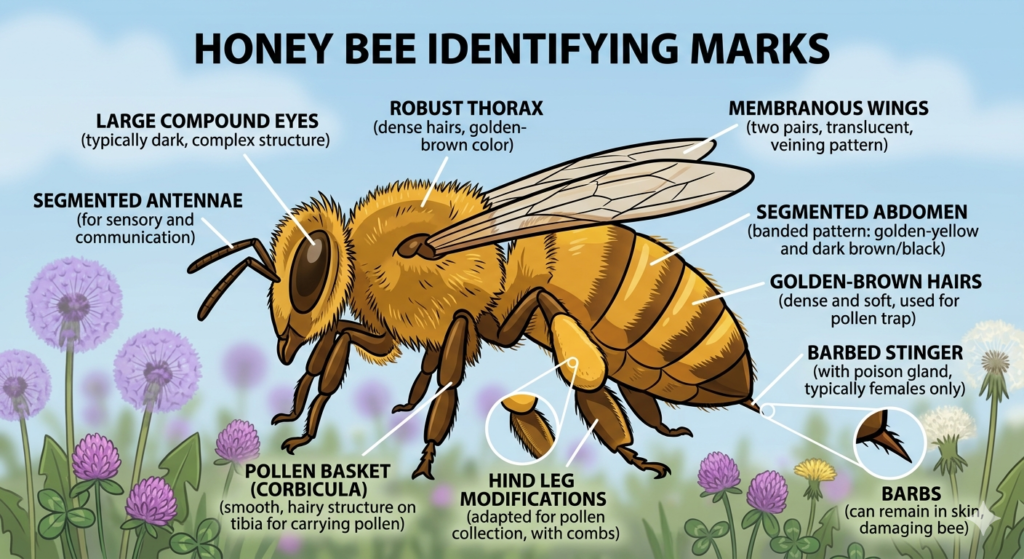
- Barbed Stings: Honey bees have a barbed stinger that usually stays lodged in the skin of mammals, leading to the bee’s death after stinging. In contrast, wasps and bumblebees have smoother stingers and can sting multiple times without dying.
- Wax Production: Honey bees have specialized glands on the underside of their abdomen that produce flakes of wax. They use this wax to build the precise hexagonal combs we associate with beehives, whereas wasps use paper pulp and bumblebees use a mix of wax and pollen.
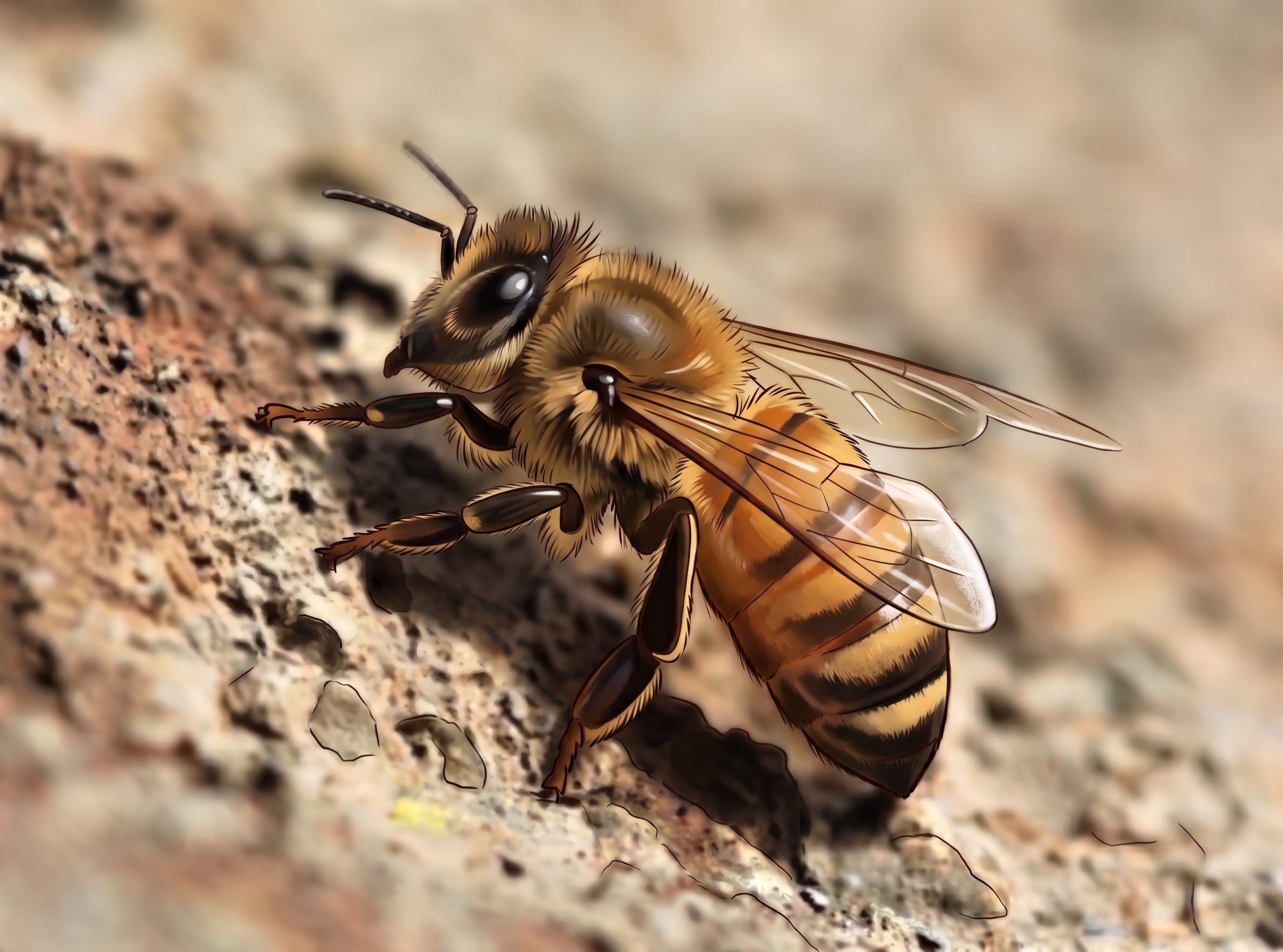
- Body Shape: They are more slender than the “round” bumblebee but more robust and hairy than the “wasp-waisted” and shiny wasp.
While wasps are predatory hunters that seek out protein from other insects, honey bees are dedicated floral specialists:
- Nectar Storage: Honey bees are the only species in Scotland that produce and store significant quantities of honey (concentrated nectar) to sustain the colony through the winter.
- The “Waggle Dance”: Honey bees have a unique, professional “language.” They perform a complex waggle dance to communicate the exact direction and distance of a food source to their hive mates – a level of sophisticated communication not seen in wasps or solitary bees.
Comparison
| Feature | Honey Bee | Bumblebee | Wasp |
|---|---|---|---|
| Colony Life | Perennial (Years) | Annual (One Season) | Annual (One Season) |
| Nest Material | Secreted Wax | Wax & Pollen | Paper (Wood Pulp) |
| Diet | Pollen & Nectar | Pollen & Nectar | Nectar & Insects |
| Stinger | Barbed (Die after stinging) | Smooth (Multiple stings) | Smooth (Multiple stings) |
Gallery

Our Removal Guarantee
Honey bee treatments are not guaranteed due to the nature of the treatment. In some situations, a professional beekeeper may be called to assist, but we cannot guarantee their work or removal process.
In rare cases where honey bee extermination is required, this can be carried out legally and safely. Because this method may require several attempts, it cannot be guaranteed. However, it does include one free return visit to check whether the bees have been removed or to re-treat the area if necessary.
Advisory Guarantee: If no nest or infestation is found, the controller will provide professional advice and charge the standard callout fee. If a nest or infestation appears within 14 days of the initial visit, we’ll return and treat it free of charge.
More details on how we remove bees and wasps are found here.
Honey Bees in Scotland
- Western Honey Bee (Apis mellifera)
- European Dark Honey Bee (Apis mellifera mellifera)
Fun Facts
Each colony is centred around a single queen, with thousands of female workers and a smaller number of male drones. Their ability to communicate through complex “dances” allows them to efficiently exploit the nectar and pollen sources provided by the Scottish flora.
A healthy managed hive can contain up to 60,000 individuals during the peak of summer, significantly outnumbering the colonies of bumblebees.